Astor AcademyGov
menu
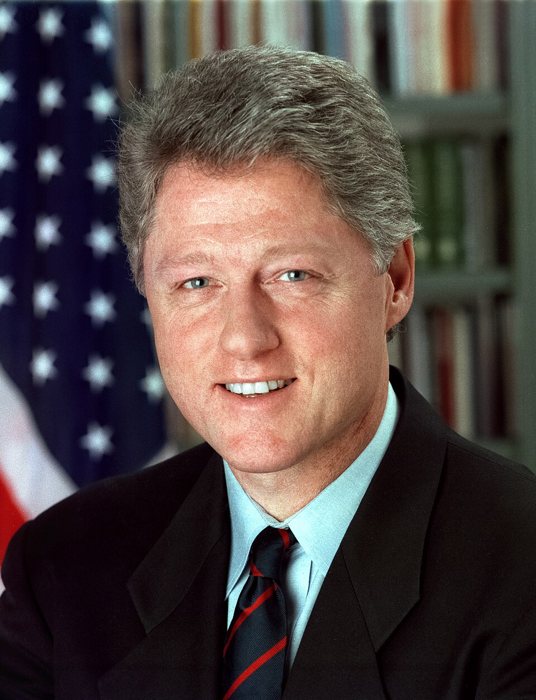
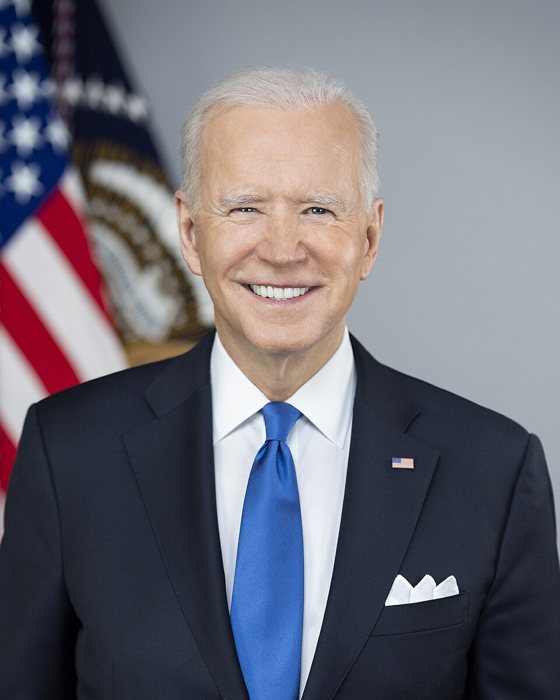
Official portrait of Bill Clinton
official portrait · Bob McNeely, The White House, 1993 · public domain · source

// 42nd president · Democrat · 1993–2001

Bill ClintonThe 42nd president

A small-state governor who won the White House in 1992 promising a "New Democrat" mix of growth, deficit cutting and social programs. His eight years brought the longest peacetime expansion then on record and the first federal budget surpluses in three decades, and also the second presidential impeachment in U.S. history.

who
William Jefferson Clinton, born William Jefferson Blythe III on Aug 19, 1946, in Hope, Arkansas.
party
Democratic
in office
Jan 20, 1993 – Jan 20, 2001 (two terms)
vice president
Al Gore
before
Arkansas attorney general (1977–79); governor of Arkansas (1979–81, 1983–92)
elections
Won 1992 (370 electoral votes) and 1996 (379)
known for
Deficit reduction and surpluses, NAFTA, the 1994 crime law, welfare reform, the Balkans, impeachment and acquittal
after office
Clinton Foundation and Clinton Global Initiative; Hillary Clinton's Senate, State Department and presidential runs
five presidencies, 1993 to the end of the current term (Jan 2029)
1993199720012005200920132017202120252029

blue = Democrat · red = Republican · Trump's two terms are split by Biden's term

electoral votes (538 total, 270 to win; line marks 270)
1992

Clinton 370 · G.H.W. Bush 168 · Ross Perot won about 19% of the popular vote but no electoral votes

1996

Clinton 379 · Dole 159 · Perot ran again (about 8%)

timeline
  1. 1946Born in Hope, Arkansas
  2. 1968Graduates from Georgetown; Rhodes Scholar at Oxford
  3. 1973Yale Law School degree
  4. 1978Elected governor of Arkansas at 32; loses re-election in 1980, wins back the office in 1982
  5. 1992Wins the presidency against George H.W. Bush and Ross Perot
  6. 1993Budget law raises top tax rates; NAFTA passes Congress; Family and Medical Leave Act
  7. 1994Health plan dies in Congress; crime law signed; Republicans win both chambers
  8. 1995Government shutdowns; Dayton accords end the Bosnian war
  9. 1996Welfare reform signed; re-elected over Bob Dole
  10. 1998First surplus since 1969; impeached by the House in December
  11. 1999Acquitted by the Senate (Feb 12); NATO air war over Kosovo
  12. 2001Leaves office; final-day pardons draw fire
§ 1

Early life and the road to the White House

Clinton grew up in Hope and Hot Springs, Arkansas. His father died in a car accident before he was born, and he later took the surname of his stepfather, Roger Clinton.

He studied at Georgetown, Oxford (as a Rhodes Scholar) and Yale Law School, where he met Hillary Rodham. He returned to Arkansas to teach law and run for office.

more details

His first race, for Congress in 1974, ended in a narrow loss. Two years later he was elected state attorney general, and in 1978, at 32, governor, among the youngest in the country.

Voters turned him out in 1980 after an unpopular car-tag fee and the fallout from Cuban refugees held at Fort Chaffee. He won the office back in 1982 and held it for ten more years, focusing on school standards and economic development.

Nationally he chaired the National Governors Association and the Democratic Leadership Council, a group of moderates arguing that the party had to win back middle-class voters on crime, welfare and the economy. That "New Democrat" pitch became the core of his 1992 campaign.

sources [1] [2]

§ 2

Elections: 1992 and 1996

In 1992 Clinton beat the sitting president, George H.W. Bush, in a three-way race with Ross Perot. He won 370 electoral votes with about 43% of the popular vote.

In 1996 he beat Senator Bob Dole with 379 electoral votes and about 49% of the popular vote, becoming the first Democrat since Franklin Roosevelt to win a second full term.

more details

The 1992 primaries nearly ended his run: reports of an affair and questions about how he avoided the Vietnam draft dogged him in New Hampshire, where he finished second and called himself "the Comeback Kid." His campaign focused relentlessly on a weak economy after the 1990–91 recession.

Perot, a Texas billionaire running as an independent, drew about 19% of the vote, the strongest showing by a non-major-party candidate since Theodore Roosevelt in 1912. Analysts still debate whether he cost Bush the race; exit polls suggested his voters split roughly evenly.

By 1996 the economy was growing strongly. Clinton ran as a centrist who had cut the deficit and signed welfare reform, and he cast Republicans in Congress, led by Speaker Newt Gingrich, as extreme after the 1995–96 shutdowns.

sources [3] [4] [1]

§ 3

First term: budget, health care and the 1994 backlash

Clinton's 1993 budget law raised the top income tax rate and taxes on gasoline and on some Social Security benefits, and expanded the Earned Income Tax Credit. It passed without a single Republican vote, with Vice President Gore breaking a tie in the Senate.

His plan for universal health coverage, developed by a task force led by Hillary Clinton, never reached a floor vote. In November 1994 Republicans won both chambers of Congress for the first time in 40 years.

more details

Early laws included the Family and Medical Leave Act (unpaid, job-protected leave for workers at larger employers), the "motor voter" registration law, and the Brady Act, which required background checks for handgun sales from licensed dealers.

The 1993 budget was sold as deficit reduction. Republicans argued the tax increases would cause a recession; instead the economy kept growing, and supporters credit the law with lowering interest rates. Economists still weigh how much of the later boom it explains versus technology, low oil prices and Federal Reserve policy.

Clinton also pushed the North American Free Trade Agreement through Congress in late 1993, relying more on Republican votes than Democratic ones. Labor unions opposed it, a split inside the party that lasted for decades.

His first weeks were consumed by a fight over gays in the military, which ended in the "Don't Ask, Don't Tell" compromise: gay and lesbian service members could serve only if they did not disclose their orientation.

sources [1] [5] [6] [7]

§ 4

The 1994 crime law

The Violent Crime Control and Law Enforcement Act of 1994 funded tens of thousands of new police officers, more prison construction, and an assault weapons ban that expired in 2004. It also created the Violence Against Women Act.

Then broadly popular, including with many Black leaders and mayors, it later became one of the most debated laws of the era because of its link to mass incarceration.

more details

The law included grants to states that adopted "truth in sentencing" rules, expanded the federal death penalty to dozens of offenses, and created a federal "three strikes" provision for certain repeat violent offenders.

Researchers disagree on its effects. Crime had already begun falling nationally in the early 1990s and kept falling through the decade. Most incarcerated people are held in state prisons under state laws, so the federal law's direct share of incarceration growth is debated, but critics argue its incentives pushed states toward longer sentences.

Clinton himself later said parts of the law made the problem of over-incarceration worse, while defending the police funding and the Violence Against Women Act.

sources [8] [9]

§ 5

Divided government: shutdowns, welfare reform and the budget deal

After 1994 Clinton governed alongside a Republican Congress. Two government shutdowns in 1995–96 were mostly blamed on Republicans in polls, and strengthened his hand.

In 1996 he signed welfare reform, which replaced the open-ended AFDC program with time-limited block grants and work requirements. In 1997 a bipartisan budget deal created the Children's Health Insurance Program.

more details

The Personal Responsibility and Work Opportunity Reconciliation Act ended the federal entitlement to cash welfare. It set a five-year lifetime limit on federal assistance for most families and required most adults to work. Welfare caseloads fell sharply in the following years. Some officials in his own administration resigned in protest, arguing it would push poor children deeper into poverty.

The same year he signed the Defense of Marriage Act, which barred federal recognition of same-sex marriages; he later said he regretted it, and the Supreme Court struck down its key section in 2013 (United States v. Windsor). He also signed the Telecommunications Act of 1996.

The Balanced Budget Act of 1997 paired spending restraint with CHIP, which covers children in families who earn too much for Medicaid. The Taxpayer Relief Act the same year cut the capital gains tax rate and created the child tax credit.

Late in his presidency he signed the Gramm-Leach-Bliley Act of 1999, which removed Depression-era barriers between commercial banks, investment banks and insurers, and the Commodity Futures Modernization Act of 2000, which kept most over-the-counter derivatives outside federal regulation. Both later drew criticism after the 2008 financial crisis.

sources [10] [11] [12] [13]

§ 6

The economy and the surpluses

The economy grew for all eight years of his presidency. The unemployment rate fell from 7.3% in January 1993 to 4.2% in January 2001, according to the Bureau of Labor Statistics.

The federal government ran budget surpluses in fiscal years 1998 through 2001, the first since 1969.

more details

The expansion that began in March 1991 lasted ten years, then the longest on record, ending in March 2001. It was driven in part by a technology investment boom and rising productivity; the dot-com stock bubble began to deflate in 2000.

Credit for the surpluses is shared and argued over: the 1993 tax increase, spending caps from 1990 and 1997, falling defense spending after the Cold War, and a surge in capital gains tax revenue from the stock market all played a role. Republicans point to the spending restraint they forced after 1994; Democrats to the 1993 law passed without Republican votes.

Median household income, adjusted for inflation, rose during the late 1990s, and the poverty rate fell. Income inequality kept widening, as it had since the 1970s.

sources [14] [15] [16]

§ 7

Foreign policy: Somalia, Rwanda, the Balkans and beyond

Clinton inherited a U.S. mission in Somalia; after 18 American soldiers were killed in Mogadishu in October 1993, he withdrew U.S. forces. The next year the U.S. did not intervene to stop the genocide in Rwanda, which he later called one of his greatest regrets.

In the Balkans, NATO airstrikes in 1995 helped lead to the Dayton Agreement ending the war in Bosnia, and a 78-day NATO air campaign in 1999 forced Serbian forces out of Kosovo.

more details

He hosted the 1993 signing of the Oslo Accords between Israel and the Palestine Liberation Organization and the 1994 Israel–Jordan peace treaty. The Camp David summit of July 2000 ended without a final Israeli–Palestinian agreement.

He backed expanding NATO to Poland, Hungary and the Czech Republic (joined 1999), supported Russia's Boris Yeltsin, and signed a 1994 "Agreed Framework" meant to freeze North Korea's nuclear program. He pushed China's entry into the World Trade Organization, which Congress smoothed by granting permanent normal trade relations in 2000.

Al-Qaeda grew into a major threat during these years: the 1998 bombings of U.S. embassies in Kenya and Tanzania prompted U.S. cruise-missile strikes in Afghanistan and Sudan, and the 2000 attack on the USS Cole killed 17 sailors. The 9/11 Commission later reviewed missed chances to capture or kill Osama bin Laden under both Clinton and George W. Bush.

sources [1] [17] [18]

§ 8

Scandal and impeachment

Independent Counsel Kenneth Starr, first appointed to investigate the Whitewater land deal, expanded his inquiry to Clinton's relationship with White House intern Monica Lewinsky and his testimony about it.

The House impeached Clinton on Dec 19, 1998, on charges of perjury and obstruction of justice. The Senate acquitted him on Feb 12, 1999; neither article won even a simple majority, far short of the two-thirds needed to convict.

more details

In a deposition in the Paula Jones sexual harassment lawsuit and later before a federal grand jury, Clinton denied or minimized the relationship. In August 1998 he acknowledged an "inappropriate" relationship in a televised address.

Starr's September 1998 report to Congress laid out 11 possible grounds for impeachment. The House approved two articles (grand jury perjury, 228–206; obstruction, 221–212) and rejected two others. In the Senate, the perjury article failed 45–55 and the obstruction article 50–50.

Public opinion largely sided with Clinton on removal: his job approval in Gallup polling reached 73% in December 1998, the highest of his presidency, even as majorities said they disapproved of his personal conduct. Democrats gained House seats in the November 1998 midterms, and Speaker Gingrich resigned.

In 2001, as he left office, Clinton reached an agreement with the independent counsel: he acknowledged giving false testimony, accepted a five-year suspension of his Arkansas law license and paid a $25,000 fine, and was not prosecuted. Separately, a federal judge held him in civil contempt in 1999 over his Jones deposition testimony.

sources [19] [20] [21]

§ 9

After the presidency and legacy

Since 2001 Clinton has worked mainly through the Clinton Foundation and campaigned for Democrats, including his wife, Hillary Clinton, in 2008 and 2016.

Historians generally rank him in the upper-middle tier of presidents, praising his economic record and political skill and faulting his personal conduct and parts of his policy legacy.

more details

He and George H.W. Bush raised money together after the 2004 Indian Ocean tsunami and Hurricane Katrina. He has written several books, including the memoir My Life (2004).

His reputation shifted again after 2017, as the #MeToo movement led some Democrats to say he should have resigned in 1998, and as files related to the financier Jeffrey Epstein renewed questions about his past association with Epstein. Clinton has said he knew nothing of Epstein's crimes and has not been charged with any wrongdoing in connection with him.

Many policies he championed, including the crime law, welfare reform, financial deregulation and free trade, were later criticized from within his own party, while the economic results of his tenure remain a reference point in both parties' arguments.

sources [1] [22]

§ 10

Criticisms, in full

Each criticism below sets out the claim, the evidence, why critics care, and the reply from Clinton or his defenders. Where facts are disputed, both readings are given.

Lying under oath and the Lewinsky affair

the claim Critics say Clinton lied under oath and tried to hide an affair with a 22-year-old intern, conduct they argue disqualified him from office.

evidence, why it matters, the reply

evidence

Clinton denied a sexual relationship in his January 1998 Jones deposition, then acknowledged an inappropriate relationship in August. The House impeached him for perjury and obstruction; a federal judge later found he gave "intentionally false" deposition testimony and held him in civil contempt. In 2001 he acknowledged false testimony as part of a deal with the independent counsel.

why critics care

Critics argue that a president who misleads a court undermines the rule of law, and that the power gap between a president and an intern made the relationship an abuse of position regardless of consent. Since 2017 some Democrats have said the party was wrong to rally around him.

the other side

Clinton's defenders argued that the conduct, while wrong, concerned a private consensual relationship and did not meet the constitutional bar of "high crimes and misdemeanors." They described the Starr investigation as a partisan effort that strayed far from its Whitewater mandate. The Senate acquitted him, and public approval of his job performance rose during the process.
sources [20] [19] [21]

The crime law and mass incarceration

the claim Critics argue the 1994 crime law fueled mass incarceration, especially of Black Americans.

evidence, why it matters, the reply

evidence

The law offered states money for prison construction if they adopted truth-in-sentencing rules, expanded federal death-penalty crimes, and added a federal three-strikes rule. The U.S. prison population kept climbing through the 1990s. Analysts such as the Brennan Center note that most incarceration growth came from state laws and had begun before 1994, but that federal incentives encouraged it.

why critics care

Incarceration rates fall hardest on Black communities, and critics see the law as part of a bipartisan "tough on crime" era whose costs, including families separated and people locked out of jobs, lasted decades.

the other side

Supporters note the law passed with support from many Black mayors and members of Congress amid high violent crime, that it funded community policing and the Violence Against Women Act, and that crime fell sharply afterward. Clinton has acknowledged parts of the law went too far while defending its intent.

sources [8] [9]

Welfare reform and deep poverty

the claim Critics say the 1996 welfare law shredded the safety net for the poorest families.

evidence, why it matters, the reply

evidence

The law replaced AFDC with TANF block grants, time limits and work requirements. Caseloads dropped steeply, and the share of poor families receiving cash aid fell. Researchers at the Center on Budget and Policy Priorities and elsewhere argue this left many families with very low incomes and no cash support, especially after the strong 1990s job market faded.

why critics care

For critics, the issue is children: TANF benefits have lost value over time, and in many states only a small share of poor families get cash help.

the other side

Supporters, including many Republicans and Clinton, point to sharp increases in employment among single mothers and falling child poverty in the late 1990s, alongside the expanded Earned Income Tax Credit, which rewards work. They argue the old system trapped families in dependency.

sources [10] [23]

Deregulation and the 2008 crisis

the claim Critics on the left argue Clinton-era financial deregulation helped set up the 2008 financial crisis.

evidence, why it matters, the reply

evidence

Clinton signed the Gramm-Leach-Bliley Act (1999), which repealed parts of Glass-Steagall, and the Commodity Futures Modernization Act (2000), which largely kept over-the-counter derivatives such as credit default swaps outside federal oversight. The Financial Crisis Inquiry Commission (2011) identified unregulated derivatives as a contributor to the crisis.

why critics care

Critics see these laws as part of a shift that let large financial firms take risks that taxpayers ultimately backstopped.

the other side

Defenders note that both bills passed with large bipartisan majorities, and that many of the firms at the center of the crisis (Bear Stearns, Lehman Brothers, Countrywide, AIG's financial products unit) would not have been covered by Glass-Steagall anyway. Clinton has argued the repeal was not a major cause.

sources [12] [24]

Last-day pardons

the claim Critics say Clinton traded pardons for access, most notably the pardon of fugitive financier Marc Rich.

evidence, why it matters, the reply

evidence

On his final day in office Clinton granted 140 pardons and 36 commutations. Rich had fled the U.S. in 1983 before trial on tax evasion and other charges. His former wife, Denise Rich, had given large sums to the Democratic Party and to the Clinton library foundation. Congressional committees investigated, and the U.S. attorney in Manhattan opened an inquiry; no charges resulted.

why critics care

The pardon power has few checks, so critics argue that any appearance that donors can buy clemency damages public trust.

the other side

Clinton wrote that he granted the pardon on the merits, citing legal arguments that the case should have been civil, and the support of Israeli officials. He denied any connection to donations.

sources [25] [1]

§ 11

Money: PACs, super PACs, philanthropy

Clinton's campaigns came before super PACs existed (they date from 2010). The money stories of his era were "soft money" to the parties, fundraising controversies in 1996, and, after office, the Clinton Foundation.

Campaign committees and PACs

His 1992 and 1996 campaigns took federal public financing for the general election, which capped spending. Primary money came from individual donors, with matching public funds.

more details

In 1996 the Democratic National Committee raised large unregulated "soft money" donations for issue ads that promoted Clinton. Investigations found the DNC had to return money from illegal foreign sources, and the White House drew criticism for inviting donors to coffees and overnight stays in the Lincoln Bedroom. A Senate committee led by Fred Thompson investigated in 1997.

Those controversies helped drive the Bipartisan Campaign Reform Act of 2002 (McCain-Feingold), which banned national-party soft money.

sources [26] [1]

Super PACs and outside groups

No super PACs existed during his campaigns. Since 2010 he has appeared at fundraisers for Democratic super PACs, including Priorities USA Action, which backed Hillary Clinton in 2016.

more details

Independent "527" groups and party soft money played the role outside groups play today. The super PAC era began after the Citizens United v. FEC decision and the SpeechNow.org v. FEC ruling in 2010, which allowed unlimited independent spending by committees that do not coordinate with candidates.

sources [27]

Philanthropy and foundations

The Clinton Foundation, founded in 2001, runs health, climate and economic development programs. Its Clinton Global Initiative brings donors together to make pledges, and the Clinton Health Access Initiative worked to lower the price of HIV/AIDS drugs in poor countries.

more details

The foundation has drawn scrutiny for accepting donations from foreign governments and wealthy individuals while Hillary Clinton was secretary of state (2009–13) and a presidential candidate. Critics argued donors could seek access; the foundation said it disclosed its donors, and reviews found no proof that donations changed State Department decisions.

Charity evaluators such as Charity Navigator have rated the foundation's finances and transparency well. It publishes its annual reports and donor lists on its website.

sources [28] [29]

See also the tracker's PACs and Philanthropy pages (New York first).

§ 12

Sources

Every section above is an original summary written for Astor Academy from the public sources below. Numbers come from official records (National Archives, FEC, BLS, CBO, court opinions, Congress) wherever possible. Last reviewed Nov 9, 2026.

  1. [1] Bill Clinton: presidential essays · Miller Center, University of Virginia
  2. [2] William J. Clinton biography · White House Historical Association
  3. [3] 1992 Electoral College results · National Archives
  4. [4] 1996 Electoral College results · National Archives
  5. [5] H.R.1 (103rd): Family and Medical Leave Act of 1993 · Congress.gov
  6. [6] H.R.2264 (103rd): Omnibus Budget Reconciliation Act of 1993 · Congress.gov
  7. [7] H.R.3450 (103rd): NAFTA Implementation Act · Congress.gov
  8. [8] H.R.3355 (103rd): Violent Crime Control and Law Enforcement Act of 1994 · Congress.gov
  9. [9] The 1994 Crime Bill: legacy and lessons · Brennan Center for Justice
  10. [10] H.R.3734 (104th): Personal Responsibility and Work Opportunity Reconciliation Act of 1996 · Congress.gov
  11. [11] H.R.2015 (105th): Balanced Budget Act of 1997 · Congress.gov
  12. [12] S.900 (106th): Gramm-Leach-Bliley Act · Congress.gov
  13. [13] United States v. Windsor, 570 U.S. 744 (2013) · U.S. Supreme Court (via Cornell LII)
  14. [14] Unemployment rate (series LNS14000000) · U.S. Bureau of Labor Statistics
  15. [15] Historical Tables (Table 1.1: surpluses or deficits) · White House Office of Management and Budget
  16. [16] U.S. business cycle expansions and contractions · National Bureau of Economic Research
  17. [17] The Dayton Peace Accords · U.S. Department of State, Office of the Historian
  18. [18] The 9/11 Commission Report · National Commission on Terrorist Attacks Upon the United States
  19. [19] Impeachment trial of President William Jefferson Clinton (1999) · U.S. Senate
  20. [20] Referral from Independent Counsel Kenneth W. Starr (H. Doc. 105-310) · GovInfo
  21. [21] Presidential job approval center (Clinton) · Gallup
  22. [22] Presidential Historians Survey 2021 · C-SPAN
  23. [23] TANF at 25: a weakened safety net · Center on Budget and Policy Priorities
  24. [24] The Financial Crisis Inquiry Report (2011) · GovInfo
  25. [25] Pardons granted by President William J. Clinton (1993–2001) · U.S. Department of Justice, Office of the Pardon Attorney
  26. [26] Public funding of presidential elections · Federal Election Commission
  27. [27] Understanding independent expenditure-only political committees (super PACs) · Federal Election Commission
  28. [28] Clinton Foundation: annual reports and contributor information · Clinton Foundation
  29. [29] Clinton Foundation rating · Charity Navigator

other presidents